


The appearance and performance of an architectural facade depend heavily on installation quality. Even carefully specified cladding materials can develop alignment problems, movement restrictions, or weather-related defects when installation details are overlooked. Experienced acm panel installers understand that facade construction involves much more than positioning panels on a wall. It requires coordination between drawings, supporting […]
The appearance and performance of an architectural facade depend heavily on installation quality. Even carefully specified cladding materials can develop alignment problems, movement restrictions, or weather-related defects when installation details are overlooked.
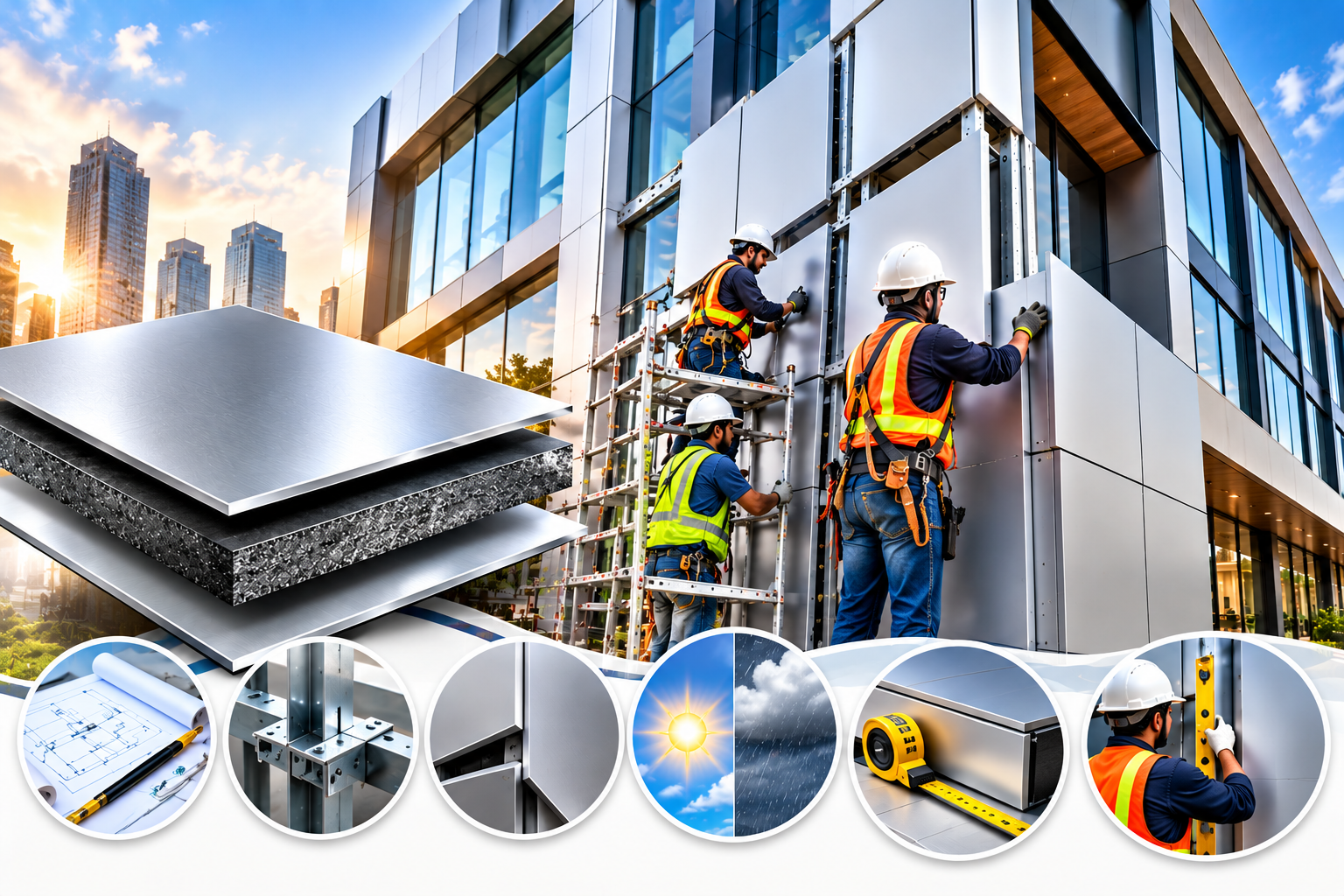
Experienced acm panel installers understand that facade construction involves much more than positioning panels on a wall. It requires coordination between drawings, supporting structures, attachment systems, and site conditions.
A systematic installation process helps translate architectural design into reliable construction.
Reviewing the Project Before Installation
Every facade project should begin with a thorough review of approved drawings and technical requirements.
Installers need to understand panel dimensions, joint locations, support spacing, fixing methods, and expected movement allowances.
ACM panel installers should also confirm that the proposed assembly matches the specified material and approved installation details.
Checking Site Conditions
Actual building dimensions may differ slightly from design drawings.
Before installation begins, teams should verify relevant elevations, openings, structural interfaces, and support locations.
Identifying discrepancies early reduces the risk of incorrectly fabricated panels or inconsistent joint arrangements.
Preparing the Supporting Structure
A reliable cladding system depends on a suitable substructure.
Rails, brackets, and other supporting components must be positioned according to the approved design.
ACM panel installers should verify alignment and connection integrity before attaching the visible panels.
Why Subframe Accuracy Matters
Small positioning errors can become noticeable across large facade areas.
An uneven supporting frame may affect panel alignment and create inconsistent surface geometry.
Proper preparation helps establish a stable reference for the remainder of the installation.
Structural connections must also satisfy the specified loading requirements.
Handling Panels During Construction
Composite panels require careful handling to preserve their surface quality.
Improper storage or movement can result in scratches, dents, or damaged edges.
Panels should be stored and transported according to the applicable material instructions.
ACM panel installers must also protect finished surfaces during cutting, positioning, and attachment.
Preventing Surface Damage
Clean working areas and suitable handling equipment help reduce accidental damage.
Protective films should remain in place or be removed according to the relevant instructions.
Fabrication tools must be appropriate for the selected panel type and thickness.
Maintaining Accurate Joint Spacing
Panel joints play an important role in both architectural appearance and technical performance.
They establish visual patterns while providing space for dimensional movement.
ACM panel installers should maintain the specified joint widths throughout the facade.
Incorrect spacing can disrupt alignment and may restrict thermal movement.
Understanding Expansion and Contraction
Aluminum changes dimensions with temperature.
The attachment system must accommodate this behavior where required by the design.
Fixed and movement-permitting connections should be installed exactly as specified.
Unapproved changes can affect the performance of the completed assembly.
Coordinating Weather Protection
Exterior cladding often forms part of a larger moisture-management system.
Installers must coordinate panel placement with flashings, drainage openings, membranes, and other weather-protection components.
ACM panel installers should pay particular attention to corners, window interfaces, and transitions between materials.
These locations frequently involve complex construction details.
Quality Checks Before Completion
Installation quality should be reviewed throughout construction rather than only at the end.
Checks may include panel alignment, attachment placement, joint consistency, surface condition, and conformity with approved drawings.
Any defects should be documented and corrected using approved methods.
Final inspections should also confirm that drainage paths remain unobstructed and required movement provisions are maintained.
Conclusion
Skilled ACM panel installers play an essential role in achieving attractive and dependable building facades. Their responsibilities extend from reviewing drawings and preparing substructures to handling panels, maintaining accurate joints, and coordinating weather-protection details. Successful installation depends on technical knowledge, consistent workmanship, and adherence to approved specifications. By following a structured process and conducting regular quality checks, installation teams can help ensure that composite cladding delivers its intended architectural appearance and performs appropriately throughout its service life.